
Foraging strategies in various animal species in recent years are mainly determined by their isotopic niche which is defined by means of stable isotope analysis. According the trophic peculiarities small mammals of the middle latitudes are grouped into herbivores, granivores, omnivores and insectivores. Herbivores (Microtus spp.) mainly feed on the green plant material, granivores (Apodemus and Micromys spp.) on seeds, fruits and/or foods of animal origin, omnivores (Myodes glareolus) on both low and high energetic plant resources and animal food, and insectivores (Sorex spp.) on foods of animal origin.
In 2018-2019 we trapped small mammals in 15 commercial orchards, berry plantations and neighboring control habitats, mainly meadows [1]. In total, 1087 individuals (11 species) were trapped. In the orchards dominant species was common vole (Microtus arvalis), 37.9% of all trapped individuals, while in the control habitats dominant was striped field mouse (Apodemus agrarius) with the share of 29.0%.
Knowing the trophic ecology of the species that occur in a given location is crucial for understanding the factors that allow their co-existence. Values of the stable isotopes provide trophic-level information that is a time-integrated approximation of assimilated diet. We used hair of the trapped small mammals to investigate $\delta^{13}$C and $\delta^{15}$N stable isotope signatures. Carbon and nitrogen stable isotope ratios were measured using an elemental analyzer (EA) (Flash EA1112) coupled to an isotope ratio mass spectrometer (IRMS) (Thermo Delta V Advantage) via a ConFlo III interface (EA-IRMS). The accuracy of measurements were better than 0.15 % for carbon and 0.2 % for nitrogen isotope ratio.
Species position according $\delta^{15}$N values formed one group of all herbivores and the yellow-necked mouse (Apodemus flavicollis) and the second of omnivore bank vole M. glareolus with the rest of granivore species. $\delta^{15}$N values in Sorex species exceed all mentioned groups 2-3-fold [2]. Compared to natural habitat of the floode meadows [2], distribution of $\delta^{13}$C values in commercial orchards was very wide (Fig. 1), especially in harvest mouse (Micromys minutus). Most distinct trophic position was characteristic to the commensal house mouse (Mus musculus).
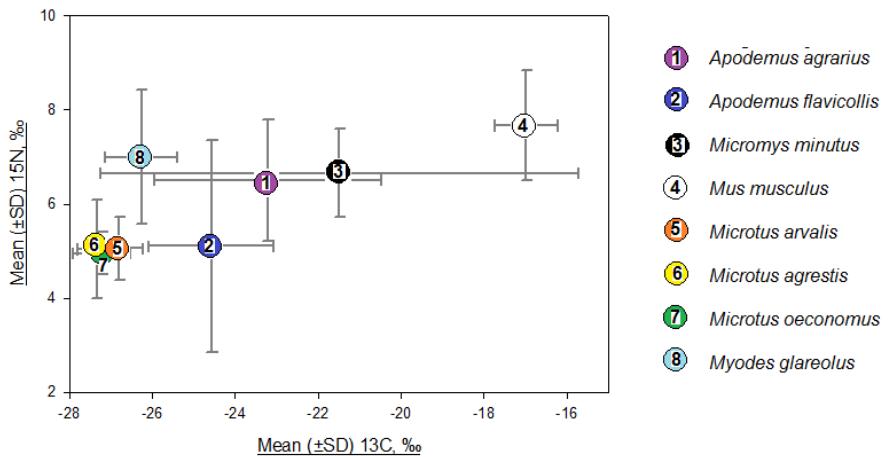
Concluding, we found that (1) small mammal diet in the orchards did not differ significantly from the surrounding meadows - this implies also migration of the animals between orchards and meadows; (2) according distribution of $\delta^{15}$N and $\delta^{13}$C values, dietary niche in the orchards is segregated between small mammal species and groups; and (3) according small mammal community composition and diet, commercial gardens are in between natural and the other agricultural habitats. We presume possible effects of season, intensity of agricultural practices and crop type on the amplitude of the trophic niche of dominant species. Preliminary, the influence of habitat on the isotopic trophic niche is species-dependent and not unidirectional, thus being difficult to make general predictions of species response.