Microcavity is an optical resonator, consisting usually of two parallel Distributed Bragg Reflectors (DBR). Such structure allows to trap light in a form of a standing wave. There are some specific electric field distributions called resonator modes, which are obtained due to the condition that the resonator length is an integral multiple of half the wavelength. Photonic modes in microcavities can couple with excitons emerging in a quantum well or different type of emitter (e.g. an organic dye), which leads to weak or strong coupling, both being a source of very interesting phenomena.
By enclosing a nematic liquid crystalline (LC) birefringent medium inside a microcavity (MC), in which LC anisotropy can be controlled by applying an external electric field, we are able to spectrally tune and couple subsequent cavity modes. [1] Recently, we have demonstrated a Rashba-Dresselhaus-like spin orbit coupling (SOC) in such structure, when modes of different parity were brought into a resonance. [2]
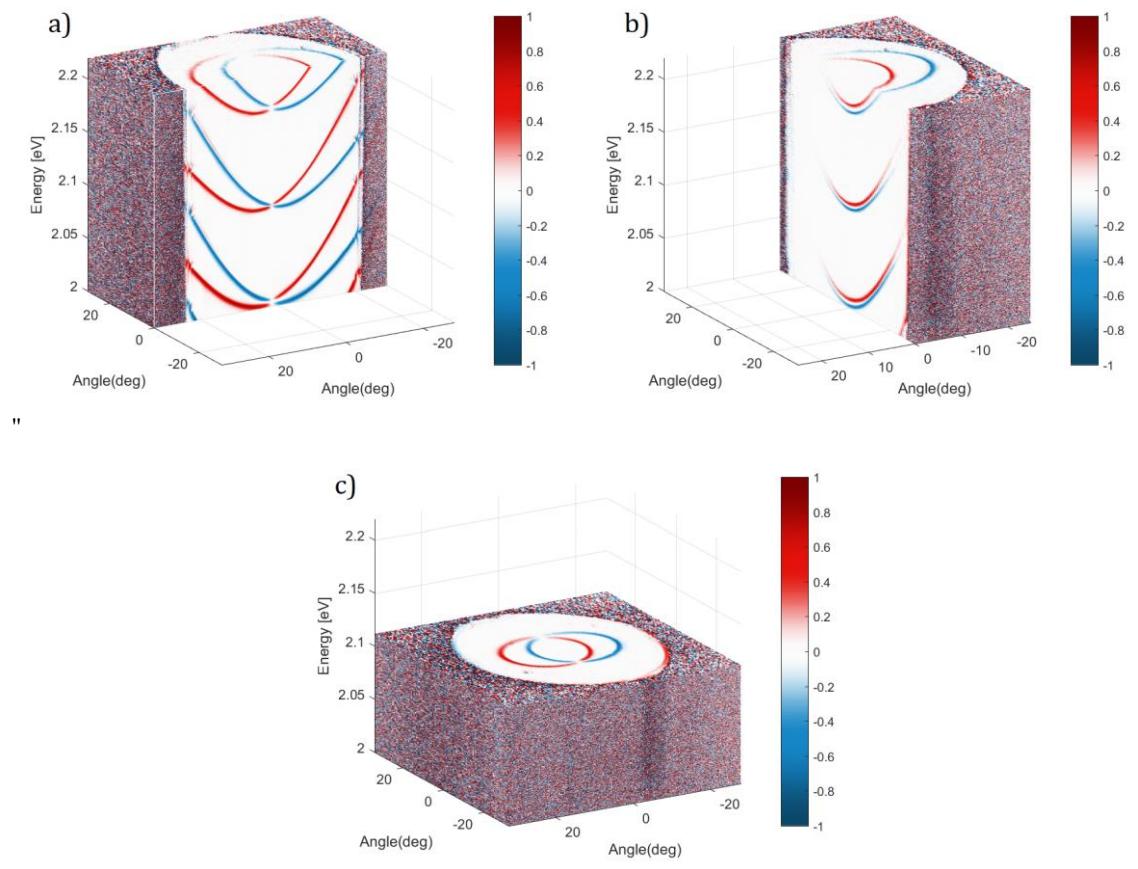
In this work, we investigate polarisation-resolved dispersion of spin-orbit coupled modes in a microcavity, that operates in weak coupling regime, with organic dye (pyrromethene-580) incorporated within LC layer. We are allowed to trace cavity modes by detecting photons emitted from the nonresonantly excited sample. We performed angle-resolved tomography to fully map dispersion relation of the cavity modes for all directions of in-plane wave vector of the cavity photons. Polarisation-resolved energy-momentum tomographies for all major regimes in LC MC were included in research: resonance of the modes with opposite parity, when they are coupled by Rashba-Dresselhaus spin-orbit coupling term (Fig. 1) and resonance of the modes of the same parity. Measurements were executed for luminescence and reflectance from the sample.