
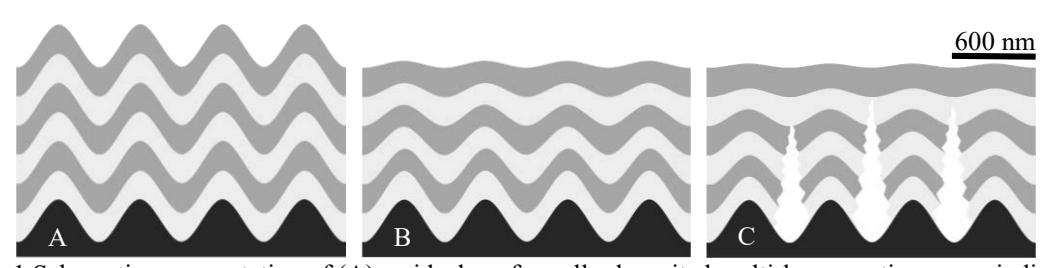
Miniaturisation of laser systems along with still holding high requirements for optical elements, raises demand for novel elements, with 2D or even 3D spatial refractive index modulation, as photonic crystals [1]. Possibilities of state-of-the-art fabrication technologies of such structures are limited due to restricted control over the formation at nanoscale. An alternative fabrication method is based on the deposition of multilayer optical coatings on modulated surfaces employing physical vapor deposition (PVD) technologies. Deposition of multilayer interference coating creates the modulation of the effective refractive index modulation in vertical direction, while pre-structured substrate surface introduces modulation in horizontal direction as well (fig. 1 A). In order to fabricate thin film based periodic structure, precise control of layers deposition is required, which leads to investigating the possibilities of conventional physical vapour deposition technologies to form such nanostructured elements.
This work presents primary experimental and theoretical results of conformal deposition of multilayer structure and formation of periodically organized microstructures on modulated surfaces. Experimental part was performed employing energetically diverse PVD technologies based on sputtering and evaporation processes. Energetic thin film deposition technology as Ion Beam Sputtering (IBS) is well-established and stands out for its highly controlled, densely packed optical coatings fabrication. On the other hand, deposition of low-energy particles potentially may help to form periodically organized microstructures with controlled porosity. In such case evaporation of thin film together with GLancing Angle Deposition (GLAD) method is required. GLAD allows to form the so called sculptured thin films by directing vapor flux towards the substrate at oblique angle. In case of periodic grating several variables appear: structured substrate relative orientation during the deposition process and the angle subtended between the substrate normal and the incident vapour flux. Considering many variables, it is important to evaluate the dependence of final structure on these values. Primary numerical simulations were performed employing NAno SCAle Modeling (NASCAM) software based on kinetic Monte Carlo algorithm [2]. This software does not take into account the vibrational movement of atoms, hence allows to investigate time evolution of relatively large systems containing millions of atoms. As both experimental and simulation results showed, film growth mode heavily depends on energy of incoming flux as well as on substrate orientation. As a result, main arising problems have been identified as modulation extinction after several layers (Fig. 1 B) and cracks formation (Fig. 1 C).
The aim of this research is to evaluate the growth mechanism of multilayer optical coatings on modulated surfaces and compare theoretical results with experimental measurements. Experimental part was performed with different PVD technologies, as IBS and electron beam evaporation with GLAD method. The possibility to control the coating formation in both ways: conformally cover modulated surface and periodic microstructure deposition, will be presented during the conference.