An important ecological and physiological parameter for assessing the influence of different salinity levels on plants' growth and development are the changes occurring in the photosynthetic apparatus, significantly the changes of chlorophyll and carotenoid content in the leaves of the plant under the influence of different environmental aspects. Salinity is recognized as one of the leading environmental factors that limit the productivity and development of plants. In general, investigations of the effect of salinity on crops are being studied more actively than other plants. Still, aquatic plants may also experience the adverse effects of NaCl and may be more sensitive to these types of changes or, vice versa, have specific adaptive mechanisms. Therefore, studies in this direction are interesting and promising to clarify this issue and help draw the right conclusions for assessing the effect on plants [2].
During the Raman spectroscopy, the whole leave-plates of the invasive aquatic plant Elodea canadensis (Michx.) were examined. It was found that cells exhibit non-uniform distribution of the chlorophyll and carotenoid molecules, which is associated with the different photosynthetic activity rates perhaps caused by various salt concentrations in water. Canadian waterweed was grown in aquarium-tanks with nutrients and various NaCl concentrations: 0 mM, 50 mM, 100 mM in a climate chamber, photoperiod (16 h day / 8 h night, 16°C, relative illumination 2500 Lux).
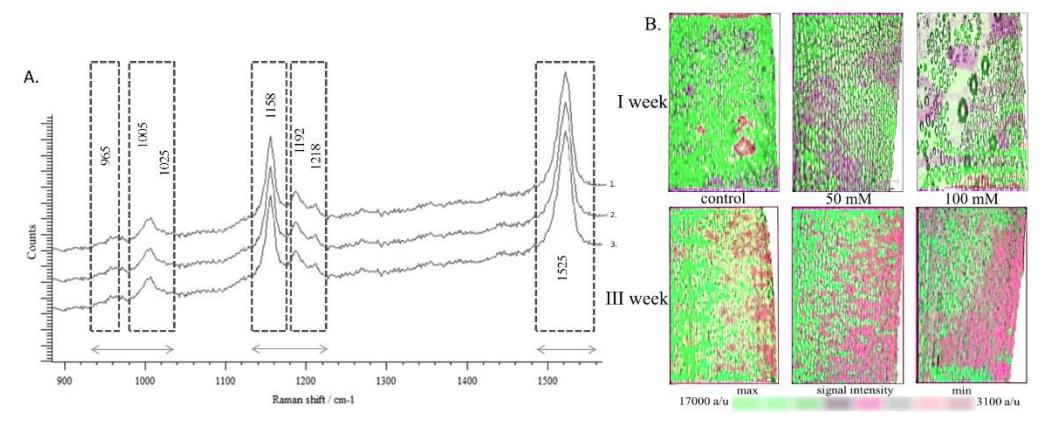
The Raman spectra were obtained by using the British Renishaw inVia Reflex system at shortened Raman shift range: 1590–850 cm-1 (Fig.1.A) and micro-mapping (Fig.1.B), excitation by Ar-ion laser $\lambda = 514.0$ nm (~9.2-26.5 mW power at the sample. Obtained Raman spectra were performed with the WiRE 3.3 program, and spectra final correction was carried out using the software package OriginPro 9.2.
The presence of a positive correlation between an increase of NaCl concentration and a decrease of the Raman signal intensity of chlorophyll a and chlorophyll b (due to overlapping signals of close peaks in some cases, it isn't easy to separate the peaks of Chl a from Chl b). The 100 mM concentration of NaCl negatively impacted the photosynthetic apparatus's functioning, and at the third week, photosynthetic efficiency decreased significantly [1], [3].
The Raman band's intensity of carotenoids depends on the level of salinity. The peak intensity of the signal of carotenoids was in the range: 395 –16800 a.u. Spectra were similar in general peaks but differ from control samples by the level of shifts signal intensity. Due to the decrease of the total intensity of all peaks in samples (100mM), an increase in the number of low-intensity peaks over the entire length of the spectrum was observed. The band in the region of 1525 cm-1 characterizes the stretching vibrations of the double –C=C bonds of the carotenoid molecule and shifts to the high-frequency region when the configuration of the carotenoid molecule changes, the band 1158 cm-1 characterizes the stretching vibrations of single C–C bonds. (Fig.1.) The simultaneous shift of the 1525 cm-1 band towards lower frequencies and band 1158 cm-1 towards higher frequencies may decrease the number of double conjugated bonds in the molecule and processes associated with the changes in the carotenoid molecules. [3]