Even with evolving technology, document forgery continues to be a major problem, causing damage to not only individuals, but also organizations, banks, and even the economy of whole countries [1]. Forgery during forensic analysis is determined by determining the contents of the document in question, specifically the chemical composition of the constituents, and comparing the differences between sections in the document [2].
The method of analysis is chosen depending on the case and its importance or urgency. Nowadays optical methods are most commonly used for investiagtion as these methods are non-destructive, fast, and easily interpreted. Raman scattering is an optical method usually used for chemical analysis in the authentication of written texts. This method allows the identification of the chemical composition of used ink and in some cases analysis of its degradation. Such information can be used to determine the time when the document was created [4]. However, the ink in written documents is difficult to analyse since fluorescence is a characteristic of some of the dyes used in the constituents of ink. Also, the amount of material in the ink is usually too small to produce a strong Raman signal what results in fluorescence overshadowing it. This problem can be solved using surface-enhanced Raman scattering spectroscopy. It is a method in which the use of noble metal nanoparticles enhances weak Raman signal and in addition quenches the fluorescence. This way the resulting spectra of studied inks allow identification and discrimination of inks made by various companies.
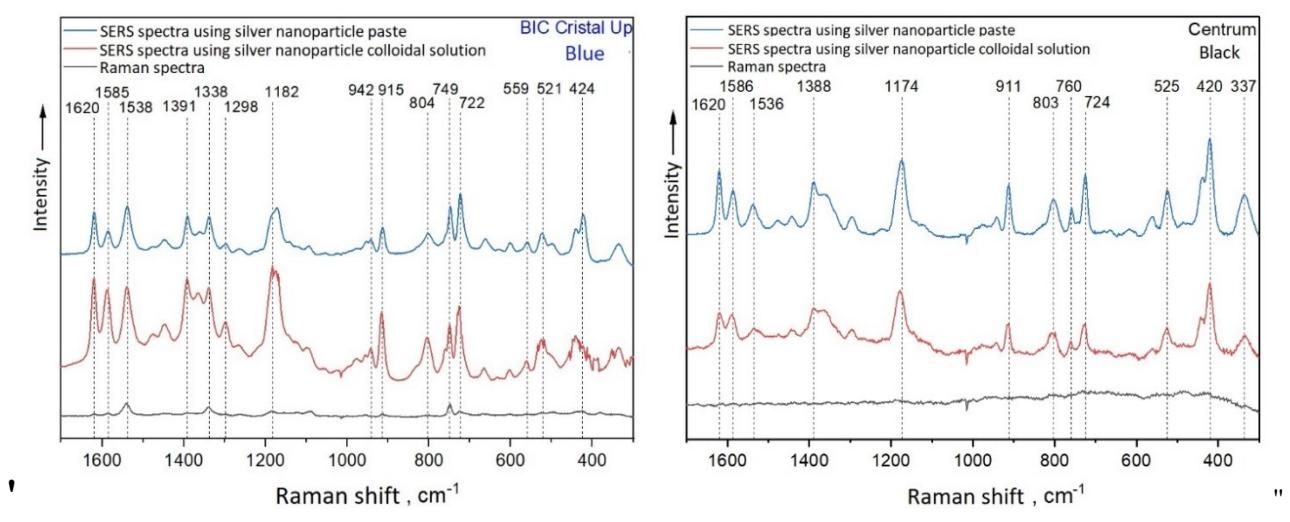
This work aimed to study inks from various companies using different types of nanoparticle solutions used for the enhancement of Raman signal. Analyzing the effects on Raman signal enhancement of different colloidal solutions allows the determination of the most practical way in differentiating various inks and different color variations (Fig. 1). The signal enhancement strongly depends on the nanoparticles size, shape, and concentration of the colloidal solution. The mixture of dyes used in the making of inks can be very similar in the products of various companies, with the only differences being the concentration of certain materials, hence the method of analysis of ink must be precise.