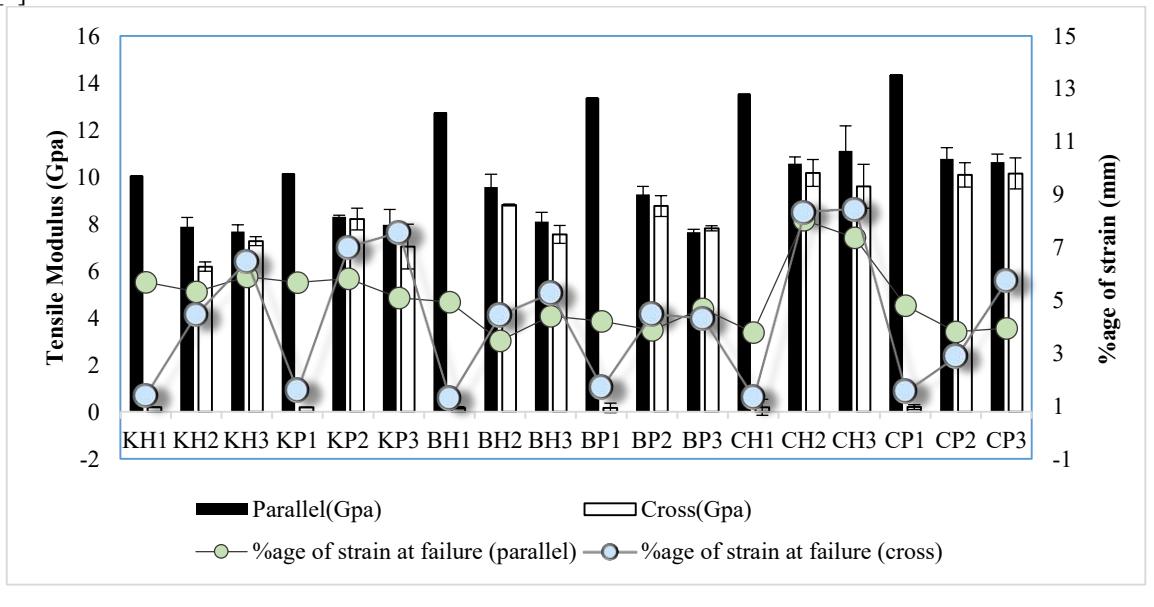
Composites materials and products have got much importance from the last few decades due to their lightweight, high strength, and high modulus [1]. In this study, we investigated the mechanical properties of knitted unidirectional thermoplastic composite prepregs. Knitted prepregs were fabricated by using thermoplastic yarns (high-density polyethylene and polypropylene) and high-performance yarns (Kevlar, Basalt, and Carbon) in a double jersey inlay structure. This was a new approach to combine the reinforcing fiber with resin forming thermoplastic fiber during the knitting operation. The structures were stacked further in three stacking sequences at different angles (0/0/0/0 0/90/0/90, 0/90/90/0), and hot compression was used to convert them into composite prepregs by melting the thermoplastic yarns. Specimen code (Inlay Yarn, Main Yarn, Plies Direction) are given as KH1(Kevlar, HDPE, 0/0/0/0), KH2 (Kevlar, HDPE, 0/90/0/90), KH3 (Kevlar, HDPE, 0/90/90/0), KP1 (Kevlar, PP, 0/0/0/0), KP2 (Kevlar, PP, 0/90/0/90), KP3 (Kevlar, PP, 0/90/90/0), BH1 (Basalt, HDPE, 0/0/0/0), BH2 (Basalt, HDPE, 0/90/0/90), BH3 (Basalt, HDPE, 0/90/90/0), BP1 (Basalt, PP, 0/0/0/0), BP2 (Basalt, PP, 0/90/0/90), BP3 (Basalt, PP, 0/90/90/0), CH1 (Carbon, HDPE, 0/0/0/0), CH2 (Carbon, HDPE, 0/90/0/90), CH3 (Carbon, HDPE, 0/90/90/0), CP1 (Carbon, PP, 0/90/0/0), CP2 (Carbon, PP, 0/90/0/90), and CP3, (Carbon, PP, 0/90/90/0).
The tensile strength and modulus were investigated according to the standard test method of ASTMD3039. Results in Fig. 1 showed that high modulus was observed in all materials when plies were stacked in the same direction i.e. 1st direction of stacking and specimen were tested in a parallel direction to yarns. As previously reported that strength of knitted thermoplastic composites is influenced mainly by orientation and as well as breakages of reinforcing components [2]. But least modulus was observed in the same specimen when tested in cross direction as there was no breakage of reinforcement yarns [3]. Because in cross direction there was the strength of only thermoplastic material i.e. resin. But materials strength was in parallel direction and as all yarns were in that direction. From the second and third direction of stacking more strength was observed in all materials in the second direction i.e. [0/90/0/90] but the difference is not much significant. As the uniform transfer of load to resin in alternative plies second stacking sequence had higher strength than the third stacking sequence. In the third stacking sequence group of two plies are stacked which causes to concentrate force [4].