
Luminescence is the light emitting process when an electron jumps from excited to a ground state. In undoped laser host material luminescence could be generated in various ways: using optical filaments, photons of light (photoluminescence), accelerated electrons (cothodoluminescence), X-ray beam (X-ray luminescence), etc.
In this work we are using filaments of light in order to induce luminescence and observe the resulting spectrum. This method is more convenient compared to cathodoluminescence or X-ray luminescence because the specimen is excited by laser beam. In this way, we have a system which is easily adjustable, requires no complex optical elements and no vacuum chamber is needed. Besides, it allows to study decay of excited states which is not possible during other experiments. Use of filaments in luminescence spectroscopy could be nondestructive way to examine transparent solid material in order to determine it's quality.
Luminescence was generated by using filaments of light. Its formation is dynamic process which is caused by non-linear matter-light interaction such as self-focusing, self-phase modulation, non-linear absorption, free-electron plasma, etc. In order to observe these processes high intensities are needed. In this experiment these intensities are reached by focusing femtosecond laser pulses into the specimen. The peak intensity of the filament is sufficient to excite impurities and charge carriers in the material. The filament induced luminescence is observed and registered from the side of the filament.
The main purpose of this work is to compare two different methods: filament induced luminescence and cathodoliuminescence. Therefore, spectra were registered in different popular laser media such as YAG, Al2O3 and KGW. Specimens were provided by different manufacturers.
Overall, it was shown that characterizing lines of impurities and defects are repeated in both experiments for all specimens (YAG, Al2O3 and KGW) provided by different manufacturers. For instance, figure 1 a) shows emission spectra of YAG specimens excited by filament, figure 1 b) shoes spectra of samples which were excited by accelerated electrons. The characteristic peaks differ in intensity, depending on the type of the excitation. Moreover, luminescence decay of these specimens were measured.
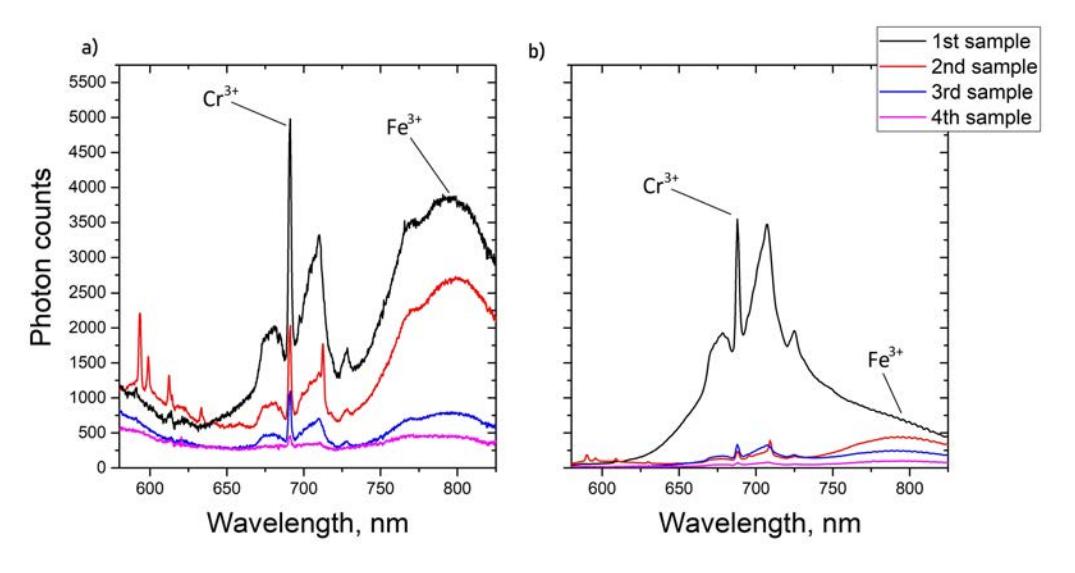
Thus, generation of optical filament is suitable way to investigate luminescence in laser host media. On the other hand, luminescence generated by filaments is more suitable method in samples which have intense luminescence. When intensity is low it is better to use cathodoluminescence experiment because light is collected from larger area of the sample's surface.