Incandescent light sources have mostly been shifted out of their application areas with the commercialization of LED lighting solutions, especially with the rise of white LEDs [1]. One of the most common ways of easily realising such a device is to combine yellow phosphor (YAG:Ce3+) dispersed in silicone or other organic resin and blue emitting InGaN chips. This kind of technology has its limitations: in application areas where high brightness of LEDs are required arises a need to use high current densities which in turn makes the junction between blue LED and yellow phosphor dramatically increase in temperature, which has an impact on the longevity of the phosphor composite. At high temperatures the thermal aging of the silicone resin is sped up, which leads to luminous efficiency degradation and constant color shift thus leading to reduction in long-term reliability [2,3]. In order to improve thermal characteristics and extend LEDs operating temperature range several solutions have been proposed in recent literature, such as, the usage of various inorganic glasses both as matrices and as composite materials for phosphors, crystallizing phosphors directly in molten glass precursors or synthesizing transparent ceramic phosphor plates [4].
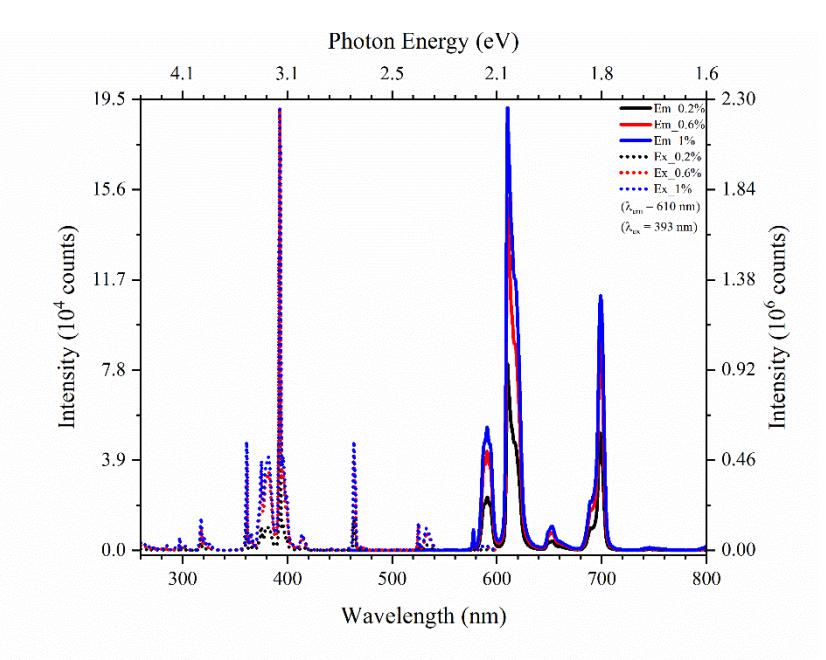
In this work phosphate glasses with different compositions were synthesized and established as host materials for Eu3+ ions. The glass precursors and luminescent materials were ground and mixed together, melted in a muffle furnace. The molten mixture was poured into premade brass molds and heated again at lower temperatures to relieve internal stress (named melt-quenching technique). The obtained samples were polished and characterized by x-ray diffractometry, scanning electron microscopy, Raman spectroscopy, photoluminescence measurements and inductively coupled plasma optical emission spectrometry.