
Biocompatible plastics are used for many different purposes (catheters, artificial heart components, dentistry products, etc. [1]). An important field for the use of biocompatible polymers is the production of vision implants known as intraocular lenses (in short – IOLs) or custom-shape contact lenses. According to statistics, about 50% of Americans have developed cataracts by the age 75-79 [2], a condition that is curable by surgically replacing the original eye lens with an artificial lens.
One of the most favorable materials in IOL manufacturing is hydrophilic acrylic – a soft, biocompatible polymer. Typically, curved surfaces are manufactured by mechanical means such as milling, turning or lathe cutting. Nowadays 2.5D objects/surfaces can also be manufactured by means of laser micromachining, that are more versatile [3]. However, due to the light-matter interaction mechanisms, the surface of the micromachined objects appears rough ~ 1 μm Ra and cannot reach optical-grade standards. These surfaces may be polished via mechanical methods; however, the process may take up to a few days [4], which makes the process economically challenging, especially when talking about custom-shape lenses. To speed up this process, alternative ways to polish IOLs are on the search.
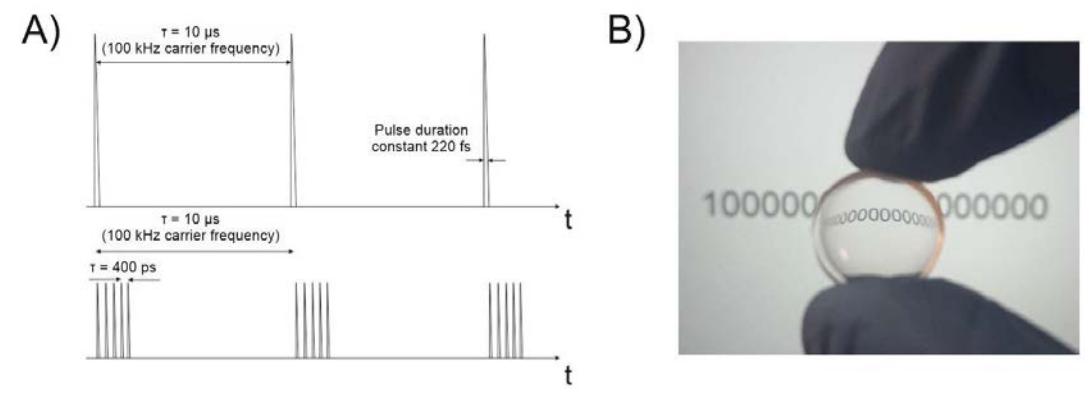
The aim of this study is the investigation of the polishing capabilities of rough (0.7 - 3 μm Ra) hydrophilic acrylic surfaces using bursts of femtosecond laser pulses (laser “Carbide”), a regime, where single pulses are divided into a sequence of sub-pulses with a time separation of 400 ps. (see Figure 1 (A)). Femtosecond laser pulses were divided into burst packets of 2, 5, 10, 25 sub-pulses, the individual amplitudes were levelled to an error of approximately 10%. Ablation of the surface was carried out on hydrophilic acrylic (Contamac CONTAFLEX 26% UV-IOL (R)) samples in a two-step process: ablating the desired shape and subsequent polishing using different burst modes. In the first step, number of samples were prepared having different surface roughness values ranging from 0.7 to 3 μm Ra. In the second step, a series of surface polishing experiments were conducted using bursts of femtosecond laser pulses, while monitoring the temperature of the surface with an IR camera. By changing different laser parameters, it was possible to produce optical-quality surfaces (surface roughness < 20 nm Ra). In addition, it was found, that the resulting Ra roughness of the surface after polishing has a clear correlation with the surface temperature during micromachining. Using the two-step approach, it was possible to produce optical components such as a concave lens from the studied hydrophilic material as shown in Figure 1 (B).