
Laser-induced periodic surface structures (LIPSS) are a universal physical phenomenon, which occurs on many materials (metals, semiconductors, dielectrics) within focal spot of the linearly polarized laser radiation [1] and find many applications in plasmonics, photonics and microfluidics [2]. Gradual transition from LIPSS to a polarization-independent low spatial frequency structures, called laser-induced periodic annular surface structures (LIPASS) in the center of the damage crater was observed [3] and more importantly, the formation of nanogratings in the volume of various materials was investigated [4]. More recently, conical third harmonic (TH) generation from in-bulk optical damage was reported and its correlation with extinction of supercontinuum radiation was unveiled [5].
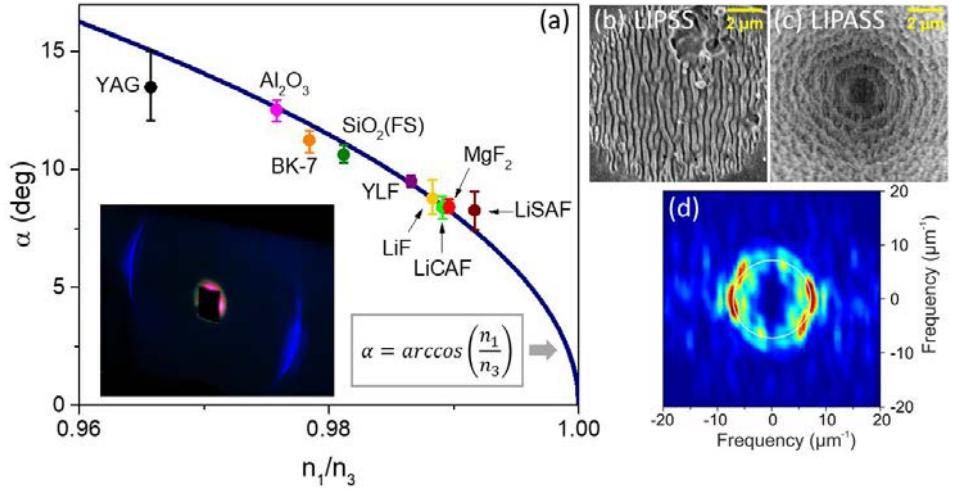
In this Study we demonstrate that filamentation of femtosecond laser pulses at high repetition rate inscribes a nanograting in the volume of transparent nonlinear material, that has a certain spectrum of periods and corresponding lattice vectors, necessary to fullfil the phase-matching condition for conical TH generation. These findings are supported by the measurements of TH cone angles inside of various nonlinear crystals and glasses: YAG, sapphire, YLF, LiF, MgF2, LiSAF, LiCAF, fused silica and BK-7 glass, performed with an amplified Yb:KGW laser that delivers 180 fs, 1035 nm pulses at 200 kHz repetition rate, see Fig. 1(a). We also investigated LIPSS and LIPASS morphology (Fig. 1(b) and (c) respectively) and the corresponding spectra of nanograting periods retrieved by 2D Fourier transform (Fig. 1(d)). Our results show that conical TH generation occurs as a noncollinear four-wave mixing process, where the TH cone angle is defined by the longitudinal phase-matching set by the material dispersion, while the transverse phase-matching involves the reciprocal lattice vector of nanograting, which is produced by high repetition rate filamentation of femtosecond laser pulses.
We believe that our study provides a deeper understanding about the nature of conical TH generation and its relation with evolving in-bulk optical damage during femtosecond filamentation and supercontinuum generation in bulk materials at high repetition rates.