
Our study consists of a theoretical model that allows predictions of epidemic evolution. It has high flexibility to adapt to a wide range of circumstances via a calibration process made with real data. In this paper, we study the Italian COVID-19 pandemic. Employing data from the first half of 2020, we got a forecast for the second half of that year.
The model presented consists of a mix of established and acknowledged epidemic evolution modelling, of which [1] is a clear and engaging introduction, and our personal view of the subject. We have opted for a complex model with a fair amount of rates to enhance flexibility at the cost of simplicity.
Every person of the whole population gets classified into one of four types: susceptible (S), infected (I), recovered (R) and asymptomatic (A). S can contract the illness by getting in contact with I or A, turning himself I or R depending on his resistance to the disease. I can recover entirely becoming R, or overcome the disease while still spreading it, becoming A in this case. R can lose immunity going back to I. A can lose the capacity to transmit the illness, finally achieving R. Every one of these transitions is controlled by an evolution rate, which needs calibration with real data.
To calibrate these rates, we have used real data from the first wave of Italian COVID-19 pandemic. From there, we have used numerical integration of the differential equations model to predict the impact of easing containment measures, ultimately leading to the second wave, as seen in Fig. 1.
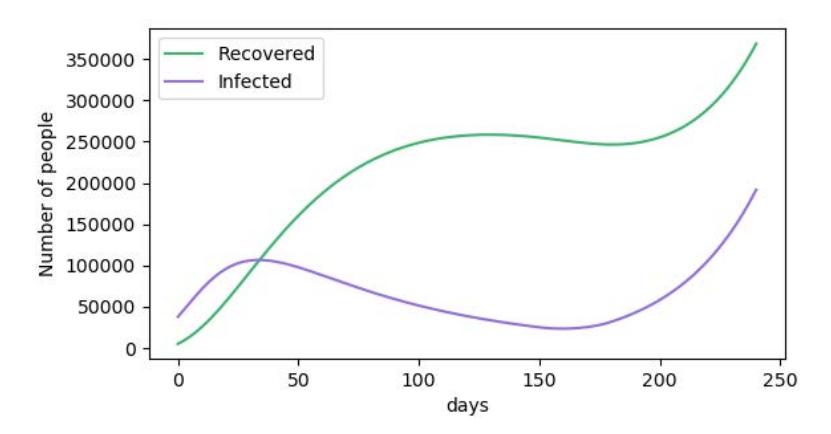
The most concerning issue when mathematically modelling an epidemic is its periodic behaviour (the so-called waves). We have considered a manual tweak of the rates to solve this problem, taking into account government decisions and population reaction to them.
However, this need for a precise selection of the parameters can be a double-edged sword. In our case, it was simple to choose rates that would fit reality because we knew the results beforehand, though it could get tricky to select adequate parameters to achieve real predictions of the future of an epidemic.
Nowadays, with the new possibilities granted by technology, we have reached a clear conclusion. The complex epidemiological models are the best way to transform existing data into predictions of the future. Its only disadvantage is the accuracy required in its parameters.
Nevertheless, neural networks with deep learning methods could accomplish this fine-tuning by intense training of this artificial intelligence. Now, with the COVID-19 pandemic at its peak, we are collecting a large amount of useful data every day. It is mandatory to take this opportunity to create a strong understanding of the evolution of epidemics, as well as a capacity to predict and contain them.