
Cutinases are hydrolytic enzymes that catalyze hydrolysis, synthesis, or transesterification reactions of ester bonds, which makes them attractive to the industrial sector [1]. One of the most promising applications of such enzymes is degradation of polymers (plastics), such as PCL (polycaprolactones) and PET (polyethylene terephthalate). These polymers are widely used in various industrial sectors (pharmaceuticals, food industry, agriculture) [2]. Thus, recycling and, most importantly, the reuse of plastic waste is a serious global problem. Nevertheless, the amount of research related to the analysis of the structure-function relationship of microbial cutinases and the perspectives of their application is limited. There are only a few publications about the isolation, purification and characterization of these enzymes [3]. In known genomes, open-reading frames that encode cutinases are difficult to identify, which makes the analysis of these enzymes even more complicated. Moreover, cutinases themselves are often classified as lipases, esterases, or other hydrolytic enzymes. Thus, there is a lack of fundamental knowledge about these bacterial enzymes.
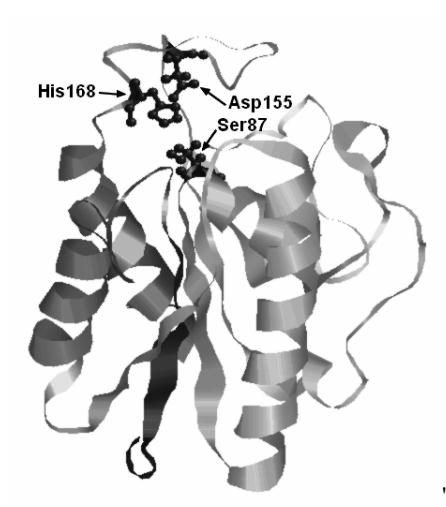
During earlier studies, a synthetic Streptomyces scabiei 87.22 cutinase was created. Some authors describe this enzyme as suberinase [4], others – as cutinase [5], whereas in UniProt database it is called secreted esterase. Since the primary enzyme under the study was a cutinase with an N-terminal signal sequence, it is important to evaluate its effect on enzyme yield and activity. In the case of lipolytic enzymes, the N-terminal signal sequence has been shown not only to lead to differences in protein yield but also in properties [6]. In this study, in silico analysis of S. scabiei 87.22 cutinase was performed. First of all, N-terminal signal sequence was predicted using SignalP-5.0 Server. Then the structure of cutinase without signal sequence (Fig. 1) and ligand binding sites were predicted with I-TASSER. Based on I-TASSER analysis results and other studies [5] catalytic amino acids were also identified. Moreover, S. scabiei 87.22 cutinase gene was aligned using Nucleotide Blast, sequences with the most similarity were chosen and conserved regions were analyzed.
The results obtained during this study would undoubtedly contribute to filling the lack of fundamental information about bacterial cutinases. Therefore, in the future it would be useful to apply mutagenesis strategies for conserved cutinase regions and this way provide more insight to the structure-function relationship.