
Electrochemical sensing has received much attention and is employed in the detection of biomolecules due to its cheap and portable instruments, low cost and rapid analysis, high sensitivity and selectivity. The selection and development of effect materials for modifying electrodes are key factors to improve the sensitivity and selectivity of electrochemical sensing. These effect materials are so-called host-guest supramolecular recognition systems. One family of candidates for effect materials as a host-guest interaction-based supramolecular recognition systems are class of cyclic oligosaccharides, namely cyclodextrins (CDs). Most well-known CDs consist of 6 to 8 joined together D-(+)-glucopyranose subunits and are called α-, β-, γ-CDs, accordingly. One important structural feature of these compounds is their conical shape with hydrophobic cavity and hydrophilic exterior. Due to this structural feature, CDs are capable of forming host-guest complexes by the means of hydrophobic interactions.
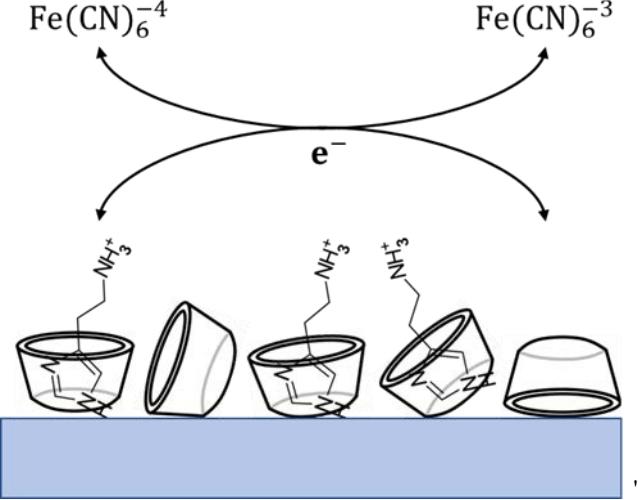
On the other hand, hystamine is important biomolecule that control physiological function of the gut and is involved in processes of our central nervous system as a neurotransmitter [4]. Therefore, the analysis of hystamine in biosamples is of great clinical and pharmaceutical importance. One example of electrochemical determination of hystamine concentration in gut involves usage of molecularly imprinted polymers as a supramolecular effect material [5]. Here, we present investigation of the self-assembled β- and γ-CD monolayers on ITO (Indium Tin Oxide) electrode as possible supramolecular platform for determination of hystamine concentration (Fig. 1). In this work, faradaic electrochemical impedance spectroscopy detection of histamine as an enhanced analyte was applied. According to equivalent-circuit modelling, the molecular recognition of histamine by the CDs cavity increases the resistive component of the electrode-solution interface while capacitive effects are negligible. Moreover, this sensor enables the quantification of histamine in a broad concentration range from 10 nM to 1 μM.