
Furfuryl alcohol (FFA) and Pyridine (Py) are, among many other compounds, food contaminants produced mainly in thermally processed food such as coffee, juices, alcoholic beverages or baked food [1,2]. Those compounds, which are considered toxic and potential carcinogenic [3], are not present in healthy humans but can be found in high concentration in breath after coffee consumption. Coffee is one of the most popular drinks and widely consumed all around the world. In 2019/2020, around 10 million tons of coffee were consumed worldwide [4]. The aim of this work is to identify and quantify Py and FFA after ingestion by using breath analysis. And compare it with the actual amount ingested by analysing the brewed coffee samples.
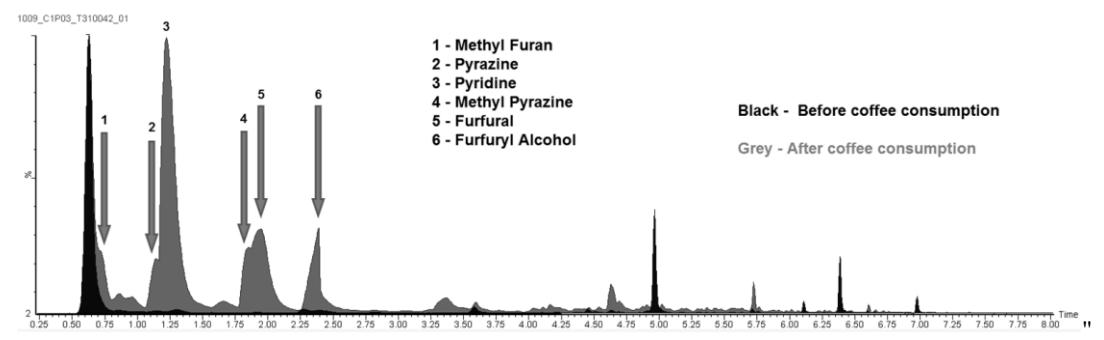
Brewed coffee samples were prepared using CafeRomatica (Nivona) coffee machine. A 10 ml aliquot of the brewed was collected to be analysed by HPLC to stablish the quantity of Py and FFA present in the sample. In order to quantify the analytes, standard addition method was employed. Breath samples from volunteers were collected before and after the consumption of the brewed coffee in order to determine the concentration detected in it. Samples were collected using self-designed LDPE plastics bags for sampling. Calibration of pyridine and furfuryl alcohol was also obtained filling the bags with the standard solutions. All the samples were analysed using Thermal Desorption coupled to Gas Chromatography Mass Spectrometer (TD/GC-MS).
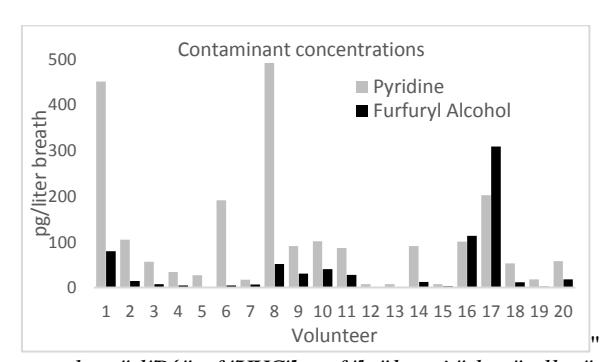
Different levels of contaminants were quantified from volunteers' samples (Fig.2). There seems to be not clear relation between the quantity of both compounds ingested and their presence in breath. Many factors, like time to drink the coffee, time after collection of the sample, eating or drinking something else while consuming the coffee, if the coffee is diluted afterwards or consumed with milk, or even the body assimilation could influence the correlation. However, breath VOCs collection can be used for the detection of food contaminants after consumption even at very low concentrations.